The Lovers
Major Arcana · air
- Upright
- Two figures beneath an angel neither of them is looking at. Union, and the choice underneath it — attraction weighed against what is actually valued.
- union · choice · alignment
- Reversed
- Wanting and valuing pulling apart. A decision made from fear or convenience, or a bond with no real agreement inside it.
- misalignment · indecision · choosing from fear
The picture
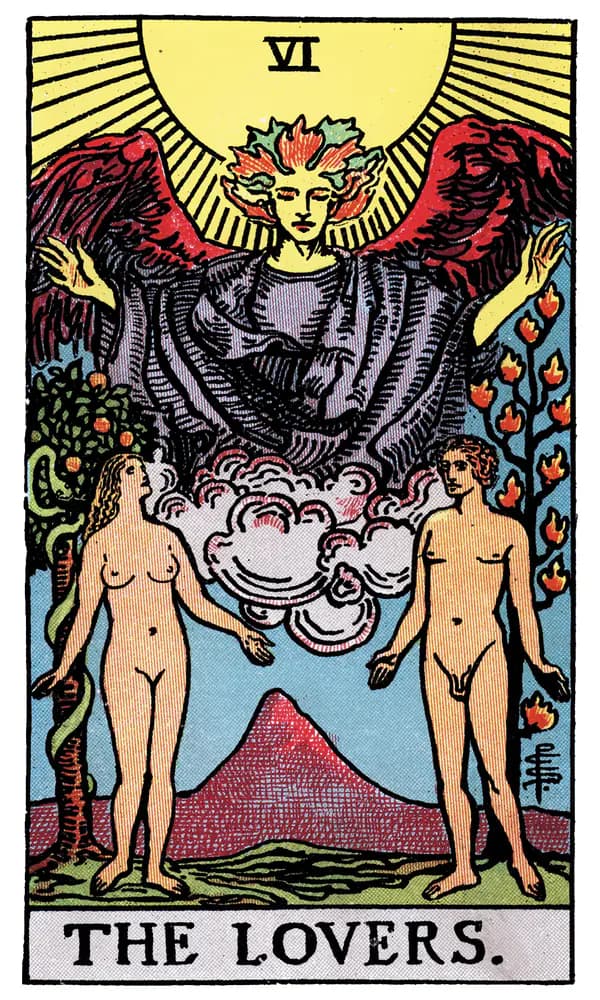
Two naked figures stand apart on a strip of green, a pointed grey mountain rising between them. Behind the woman, a tree bearing fruit with a serpent wound up its trunk. Behind the man, a tree with twelve flames on its branches. Above them both, an enormous winged figure with flame-coloured hair spreads its arms out of a cloud, in front of a sun that fills the top of the card.
The sun is directly overhead, so nothing casts a shadow anywhere in the picture.
Upright
Union, and the choice sitting underneath it.
The Lovers is a love card and has never been only a love card. Its actual subject is alignment — the moment when what somebody wants and what they value point in the same direction, and the moment they discover that these are two different directions.
The two trees make the argument. One is desire, with its serpent and its fruit. One is knowledge, burning. The figures stand between them, and the angel above does not indicate which to take.
Who is looking at whom
This is the detail most descriptions of the card get wrong, including by omission.
The man is looking at the woman. The woman is looking up at the angel. Neither of them is looking at the other's tree, and there is no moment in the picture where the two of them meet each other's eyes.
That chain — man to woman to angel — is the card's real structure, and it is not symmetrical. One of them is oriented toward the person in front of him. The other is oriented toward something above both of them. Both of those are forms of love and they are not the same form, and the card is drawn at the exact moment when that difference has not yet caused any trouble.
Which is why it works as well for a career decision or a move or a break with a family as it does for a romance. What it describes is two goods that have started to require different things, before anybody has said so out loud.
Reversed
Wanting and valuing coming apart, with the person aware of the gap and managing it.
In practice this shows up as a decision made from fear or convenience and then vigorously defended — the safer option taken, the justification assembled afterwards and rehearsed until it sounds like conviction. It also covers a bond with no actual agreement inside it: two people cooperating smoothly for years without ever having established what either of them is for.
What it is not
A promise that the relationship is the right one. The card says a choice is present. It is entirely silent on which way the choice goes, and readings that treat it as approval are supplying an ending the picture withholds.
It is also read as romance and nothing else, which loses most of its usefulness. The card turns up constantly for situations with no romantic content whatsoever, because what it names is the point at which two things somebody wants stop being compatible with each other.
In a reading
In an outcome position it rarely resolves to romance; more commonly it marks the point at which something has to be chosen and the choosing can no longer be deferred. In an obstacle position it says plainly that the reader is attempting to have both, and this card is unusually firm that they cannot.
Beside the Devil, the question becomes what the attachment is costing. Beside the Hierophant, whether the choice is actually theirs or was inherited from somebody who made it first.