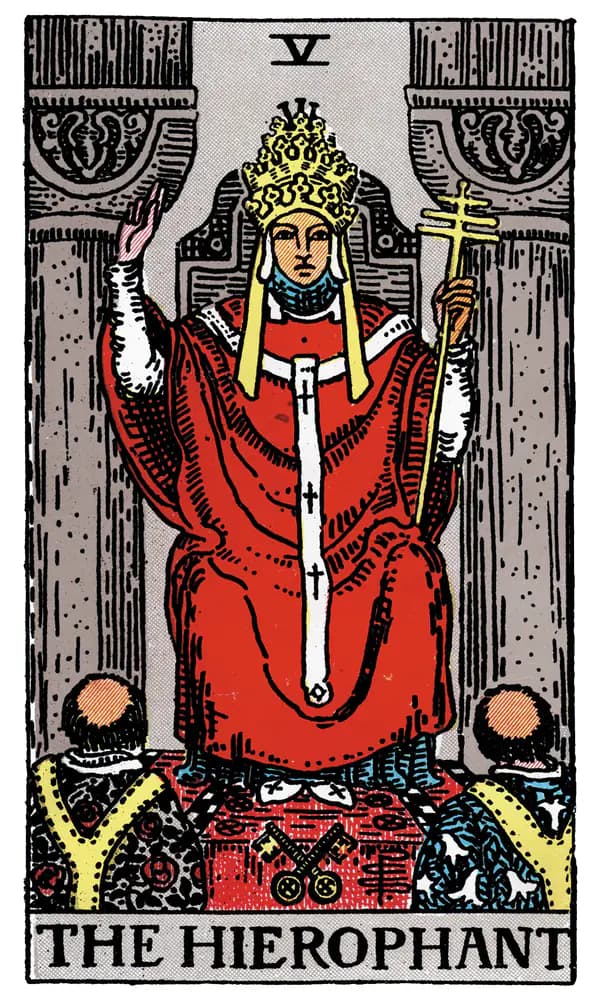
The Hierophant
Major Arcana · earth
- Upright
- Two keys crossed and two students kneeling; the teaching handed down intact. The use of an established form, and the weight of belonging to one.
- tradition · teaching · shared form
- Reversed
- Doctrine outliving its purpose, or a rejection of it made before it was understood. Rules kept for the sake of the keeping.
- dogma · hollow authority · unexamined revolt
The picture
A figure in a triple crown sits between two grey stone pillars, one hand raised in blessing, the other holding a sceptre topped with a triple cross. Two gold keys lie crossed at his feet.
Two men kneel in front of him, and we are looking at the backs of their heads. One wears a robe patterned with roses, the other lilies. The pillars are solid and there is no gap between them — unlike the High Priestess, who sits in front of a veil, this figure has nothing behind him at all. Everything in the card is front-facing, and everything in it is being taught.
Upright
The use of an established form, and the weight of belonging to one.
The Hierophant is the transmission of knowledge that already exists: the tradition, the training, the institution, the way it has been done by everybody who did it before. The keys are being handed over, not found. Somebody has them, somebody is receiving them, and there is a correct order in which this happens.
People bring their suspicion to this card and the suspicion is not baseless. It is also the card of apprenticeship, of a mentor who was worth the deference, and of the considerable relief of not having to invent the whole thing from first principles by oneself. Both of those are true at once and the card does not choose between them.
We are standing behind them
The two students are drawn from behind. Their faces are not available, their expressions are not part of the picture, and the position the viewer occupies is a few feet further back in the same room.
That places the reader inside the congregation and not outside it, and it is the most quietly demanding thing about this card. Whatever institution is in question, the picture assumes membership. Not approval — the roses and lilies on the two robes are the same pair of flowers growing wild in the Magician's garden, here issued as uniform — but presence. You are in the building.
Anyone drawing this card who feels immediately defensive about it might start there. The card is rarely asking whether to join something. Far more commonly it is naming something already joined, and asking what is being got for the dues.
Reversed
Doctrine outliving its purpose. The form kept up for the sake of keeping it up, long after the last person who could explain it stopped attending.
The mirror image turns up just as readily: a rule broken by somebody who never learned it. That is not freedom and this card knows the difference precisely. The apprentice who leaves after seven years and the one who leaves after seven weeks have not done the same thing, whatever either of them says afterwards.
In a reading
The advice reading is almost always the same and almost always unwelcome: find somebody who has already done this. In an obstacle position the card names the convention, the institution or the expectation the reader is up against, and it is worth checking whether that thing is actually in the way or merely in the room.
With the Lovers alongside, the question turns toward vows and public commitment — what gets promised in front of witnesses. With the Devil, a harder pairing: which of the structures a person lives inside are holding them up, and which are only holding them.