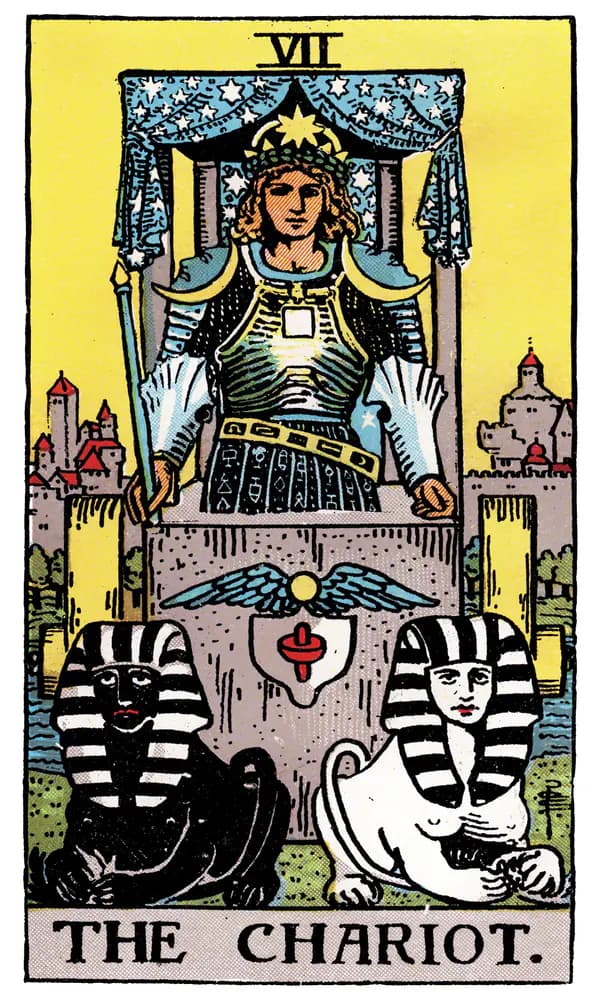
The Chariot
Major Arcana · water
- Upright
- Two sphinxes pulling opposite ways, held by will alone — there are no reins. Direction achieved by force of attention, for as long as it holds.
- will · direction · hard-won control
- Reversed
- The grip slipping, or clamped down harder. Motion without a chosen direction, or a direction held so tightly that nothing else gets in.
- scattered force · losing the thread · forcing it
The picture
An armoured figure stands in a stone chariot under a blue canopy sewn with stars. Crescent moons sit on his shoulders as pauldrons, each with a face in it. A square is fixed at the centre of his breastplate and his belt and skirt are covered in symbols. He holds a short rod in one hand. There are no reins anywhere in the picture.
Two sphinxes sit at the front of the chariot, one black and one white. Behind him, a walled city with red roofs, and a river between the city and the chariot.
Upright
Direction achieved by force of attention, and held for as long as the attention holds.
The Chariot is willpower, and the picture is careful about what kind. Nothing is harnessed. The two sphinxes are not tied to the vehicle, not bridled, and not agreed with one another about anything — one is black, one is white, and their bodies point away from each other. Whatever keeps this arrangement pointed in a single direction is coming out of the driver, continuously, and it is not attached to anything.
The city behind him is drawn small. He has left it, and the river lies between, and there is no route back into the frame.
Nothing is moving
Both sphinxes are lying down.
That is not a detail the card's reputation prepares anyone for. This is the deck's great image of victory and momentum, and the vehicle is stationary. The animals are couchant, front paws forward, entirely at rest. The driver is upright, armoured and composed, going nowhere at this precise instant.
Which makes the card considerably more honest than the version generally described. What it shows is not the journey. It is the moment of alignment before or between movements — everything pointed the right way, nothing yet expended. The concentration that will be needed has not been spent yet, and the sphinxes have not yet had a chance to disagree.
A card of triumph would have shown the ride. This one shows the instant before, which is the only instant at which the will is wholly undivided.
Reversed
The grip slipping. Motion with no chosen direction behind it — busy, quick, extremely occupied, and arriving nowhere anybody planned.
There is a harder version where the grip does not slip at all but clamps down. A direction held so tightly that nothing new is admitted, including the information that would have changed it. Reversed, this card sometimes describes somebody doing everything right at speed, in a direction chosen eighteen months ago and never revisited.
Commonly mistaken for
Easy momentum. Nothing in this picture is easy and nothing in it is automatic — there is no harness, so every bit of the alignment is being supplied by a person and will stop when he does. Read as a card of effortless progress, it sets up precisely the disappointment it was drawn to warn about.
It also gets read as conquest. The sphinxes are still two different colours at the end of the ride, and nothing in the card suggests they were ever reconciled to each other.
In a reading
Progress by effort and not by luck, and worth distinguishing from the Wheel for exactly that reason. Where the spread asks for advice, the Chariot wants a decision about direction and then everything else subordinated to it, which is the part most people would prefer to skip.
Against Strength the pairing is the reading: two approaches to the same animal, one by force of will and one by patience, and most situations respond to only one of them. Among swords the will sharpens into argument and gets harder to put down.