The Emperor
Major Arcana · fire
- Upright
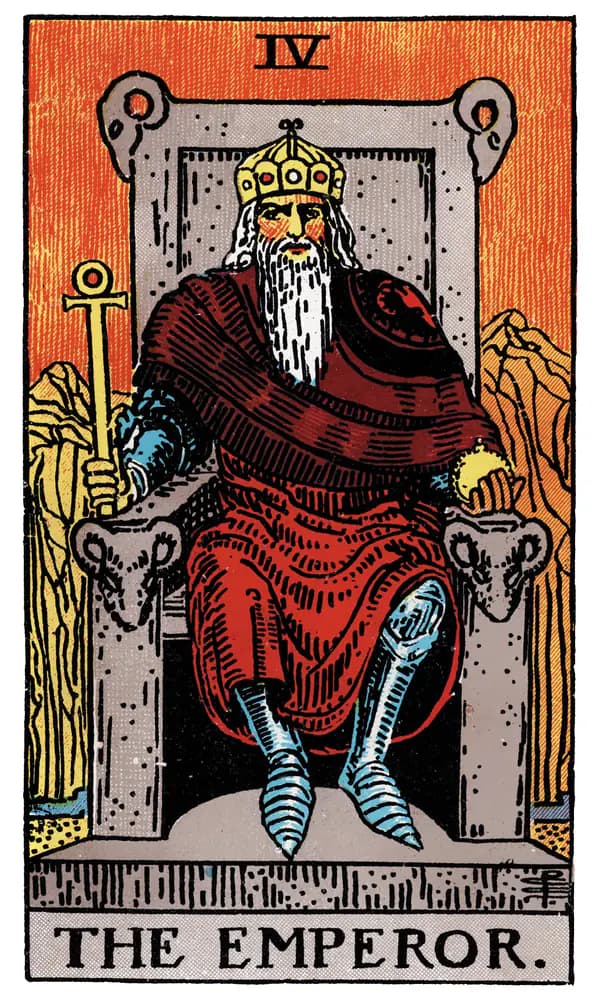
- A stone throne in a barren landscape, armour still on beneath the robe. Order imposed and then defended — structure as both shelter and limit.
- structure · authority · boundaries
- Reversed
- Control hardened past its purpose. Rigidity, or authority used to settle what it can no longer actually hold together.
- rigidity · domination · brittle control
The picture
A grey stone throne with four ram's heads carved into it, two on the back and one on each arm. The man on it holds an ankh-headed sceptre in one hand and a plain globe in the other. White beard, gold crown, red robe.
Under the robe he is wearing armour. It shows at the wrists and again at the shins, blue metal, and his feet are armoured too. Behind the throne, orange mountains with nothing growing on them. In the bottom left corner, almost out of frame, a thin stream comes down off the rock. It is the only living thing in the card.
Upright
Order imposed, and then held in place by somebody.
The Emperor is structure — the rule, the boundary, the shape that stays put long enough for other things to happen inside it. The barrenness is the point rather than an accident of composition. This is not a card about what grows. It is a card about what stops the ground from washing away, and those are different jobs that get confused constantly.
He is in full armour on his own throne, in his own territory, with nobody threatening him in the picture. That is either vigilance or an inability to stop, and the card declines to say which. Authority here is real and it is also unrelieved work.
The one stream
The bottom left corner is the one to check. There is water in this card, and it amounts to a thread.
That thin fall of water is the whole argument for the Emperor, and it would be easy to crop out and never miss. Everything else in the frame is stone, metal, and dead mountain. The one living thing survives because the arrangement holds the rock in place around it.
Read the card without the stream and it is only a picture of hardness. Read it with the stream and it becomes something more defensible: structure is not the opposite of life, it is what a small amount of life needs in order not to be washed off a mountain. The Emperor is worth having for the sake of the water, and he is not the water.
Reversed
Control hardened past its purpose. The situation moved and the rule did not, and the rule is now being defended for its own sake by somebody who can no longer remember what it was protecting.
The other reversal is louder. Authority used to settle what it has stopped being able to hold — the raised voice standing in where legitimacy used to be, force compensating for a structure that quietly stopped working some time ago. The armour is the giveaway. It tends to get heavier exactly as the thing underneath gets weaker.
Commonly mistaken for
Tyranny, which is the reversed card being read upright. The Emperor as drawn is the reason anything at all can be relied on: the deadline that means something, the boundary that holds, the person who does what they said they would do on the day they said it.
He is also read as a father, which is often apt and just as often lazy. The card names a function. Plenty of people occupy it who are nobody's parent, and plenty of parents never occupy it at all.
In a reading
Where the spread asks for advice, this card wants a boundary or a plan, and generally one that has been discussed for months. In an obstacle position it tends to point either at somebody else's rule — a policy, an institution, a father — or at the reader's own inflexibility, and telling those two apart is most of the work of the reading.
Set against the Empress it becomes one half of a whole. Among wands it reads as ambition with a spine behind it. Among cups it can turn cold, and the coldness is worth naming out loud when it does.