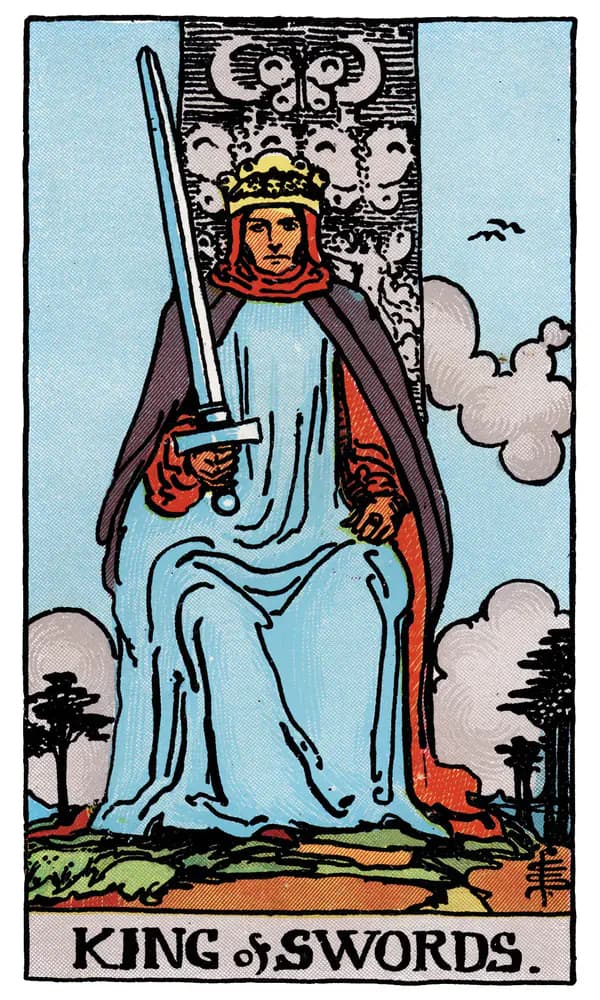
King of Swords
swords · minor arcana · air
- Upright
- Seated in judgment with the sword held slightly off vertical. Principle applied to a particular case, which is where principle gets difficult.
- judgment · principle · intellectual authority
- Reversed
- The principle used as a weapon. Reason indifferent to cost, or an authority that can argue itself right about anything.
- cold rule · argued into cruelty · rationalising
The picture
A king sits facing straight out, on a stone throne with a tall back panel carved with butterflies and a crescent moon. He wears a blue robe under a grey-purple cloak, and a gold crown over a red cap.
His right hand holds a sword up. The blade is tilted — leaning a little to one side, not quite upright.
His left hand rests on his knee, closed, with a ring on it.
He is at ground level. There is grass under the throne and trees on both sides, and two birds in the sky at his shoulder.
Upright
Principle applied to a particular case, which is where principle gets difficult.
The King of Swords is intellectual authority: the standard, the rule, the reasoned position other people defer to without being made to. He is the suit's endpoint — thought that has hardened into structure and can now be leaned on.
He is also the only court card in this suit at ground level. The Queen is above the clouds and the Knight is off the ground entirely. This one is sitting on grass, between trees, in the same world as whoever is bringing him the case.
The sword is not vertical
It leans. Not much, and unmistakably.
A vertical blade would be the obvious way to draw impartiality, and it is what the composition is set up for — a frontal throne, a symmetrical panel, a figure square to the viewer. The one element that could complete the symmetry is off by several degrees.
That tilt is the most honest thing on the card. Every actual judgement is made by a person who is somewhere in particular, has been up since six, and has met one of the parties before. The card does not present impartiality as achievable. It presents somebody doing the work anyway, with a slight and visible lean, and not hiding it behind a straighter picture.
The closed left hand belongs to the same idea. He is not receiving anything. The Queen's open palm is across the table.
Reversed
Principle used as a weapon. Reason indifferent to what it costs, correctness pursued well past the point where it does anybody any good, and the pursuit itself defended as rigour.
There is also the authority that can argue itself right about anything. The intelligence entirely intact and now working backwards from the conclusion, at speed, with better sources than anyone opposing it.
Commonly mistaken for
Coldness. He is not unfeeling; he is deciding, and deciding well requires setting certain things aside for the duration. The card is about that discipline rather than about its absence, and the discipline is temporary by design.
It gets read as a profession — lawyer, doctor, judge. Convenient, and it narrows a card describing a way of thinking into a card describing a job.
In a reading
Where a spread asks what to do: settle the principle and then apply it evenly, beginning with yourself, which is the half most people skip. As a person, whoever is currently holding the standard for everybody else.
With Justice, the impersonal and the personal versions of the same act. With the Queen, principle against discernment, and the tilt in his blade is where the argument between them starts.