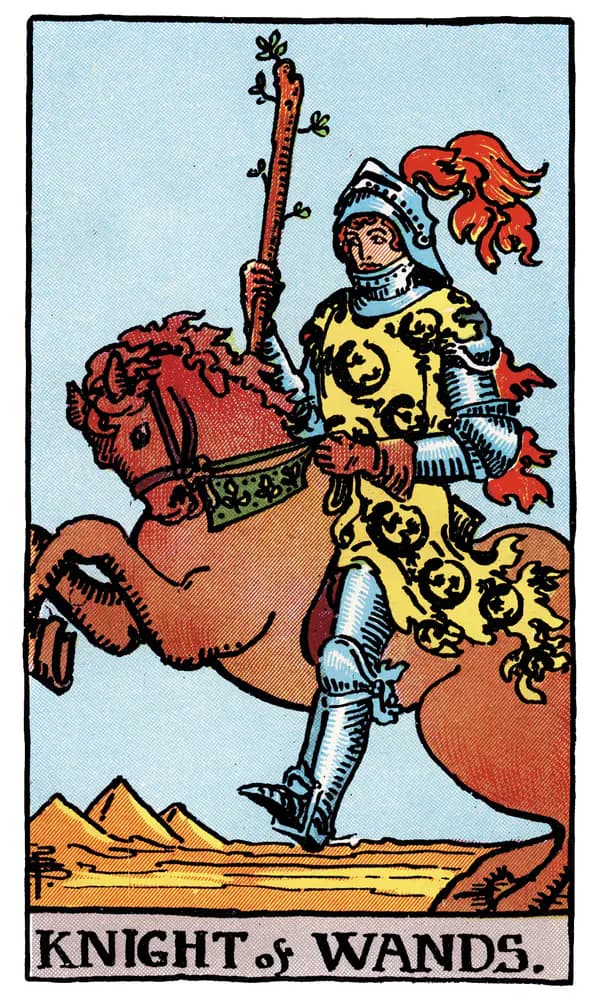
Knight of Wands
wands · minor arcana · fire
- Upright
- The horse already rearing, armour on, no enemy anywhere in sight. Charge as a temperament — the going matters more than the arriving.
- bold action · momentum · charisma
- Reversed
- The charge gone wrong. Haste with no aim, a temper that arrives ahead of the thought, or a dozen things begun and none carried.
- recklessness · impatience · burnout
The picture
A knight on a red-orange horse, mid-leap, front hooves off the ground. The horse's mane and tail are the colour of flame and its head is thrown up.
He is in armour under a yellow tabard covered in black salamanders. Red plumes stream from the helmet and from the joints of the armour. His visor is up and his face is visible. The staff in his hand is in leaf.
Behind them, three small pyramids and a great deal of empty desert.
Upright
Charge as a temperament — where the going matters more than the arriving.
Knights are their suit in motion, and this is the most kinetic card in the deck: bold, quick, magnetic, and not in any sense strategic. The horse is doing much of the deciding and the rider has no objection.
That energy is genuinely valuable. It starts things that would otherwise never start, it carries other people along, and it does not sustain itself for very long.
There is nothing to charge at
The desert is empty. There is no enemy, no road, no gate, no rival, and the only structures in the picture are three pyramids so far off they are the size of his boot.
He is not charging at something. He is charging.
Which is the honest content of the card, and it is why the Knight of Wands is so much easier to enjoy than to work with. The energy is real, the direction is arbitrary, and the picture contains no information at all about where this is going because that question has not yet come up.
The visor being up belongs to the same reading. Nobody expecting to meet anything rides with an open face.
The salamanders on his tabard are worth a look. Every one of them is drawn open, mid-crawl, unlike the closed rings on the King's chair. Even the decoration on this card refuses to complete a circle.
Reversed
The charge gone wrong. Haste with no aim behind it, or a temper that arrives before the thought and apologises afterwards, repeatedly, with complete sincerity.
There is also the trail of starts: a dozen things begun with real conviction and none of them carried, the same energy spent in short bursts, and a growing private suspicion that this is a pattern rather than a run of bad luck.
What it is not
Progress. Movement and progress are different things and this card only guarantees the first. Read as advancement, it flatters what may well be thrashing.
And it is read as a specific young man, which is a waste of it. As a mode it is recognisable to almost everybody, and most people can date the last time they were in it.
In a reading
In an advice position: commit and go, and accept what that costs, because it will cost something and the card is not pretending otherwise. In an obstacle position it names impulsiveness, the reader's or somebody else's, and it is worth establishing which.
With the King the difference is direction. With the Eight, two cards about speed — one personal, one entirely impersonal.