Eight of Swords
swords · minor arcana · air
- Upright
- Bound and blindfolded among swords that leave a clear gap on either side. A trap that is real, and not as closed as it feels.
- feeling trapped · restrictive belief · powerlessness
- Reversed
- The bindings tested. Seeing the gap and moving toward it, or an argument for staying stuck that keeps getting better.
- seeing the way out · testing the binding · deeper entrapment
The picture
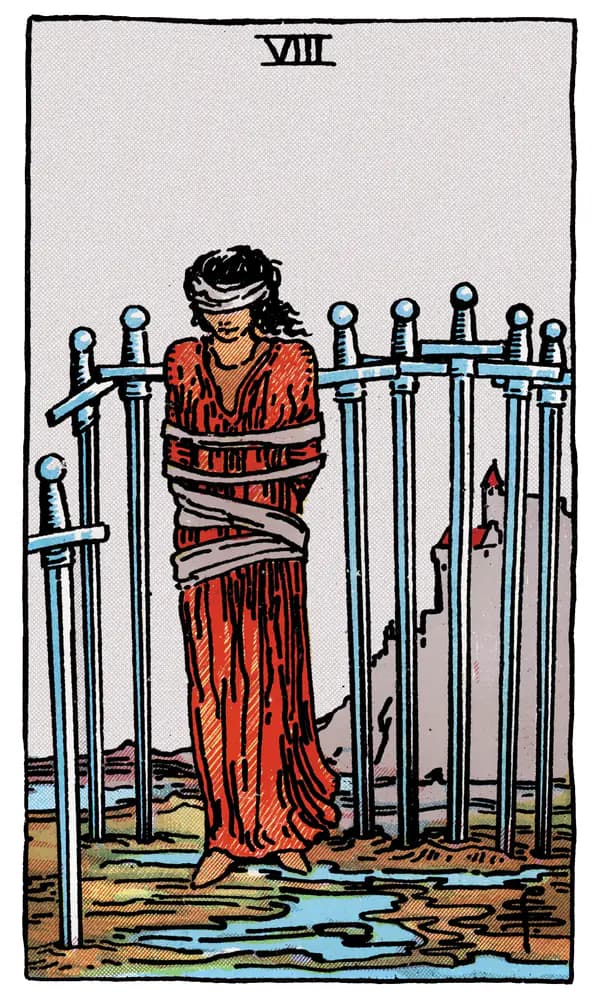
A woman in a red dress stands blindfolded with white cloth wound around her arms and upper body. Eight swords are stuck point-down into the ground around her — two on the left, six on the right.
She is standing in shallow water. Her feet are bare and nothing is tied around her legs.
In front of her the ground is completely open. Behind and above, on a rock, a castle.
Upright
A trap that is real, and not as closed as it feels.
The card is drawn with great care. There is a way out — forward, unobstructed, no sword anywhere near it — and she cannot see it, because of the blindfold, and cannot easily take it, because of the bindings. Both constraints are genuine and neither is imaginary.
This is the mental trap: the belief that has hardened into a wall, the situation that was difficult and has been converted into impossible. The card does not dismiss the difficulty and does not accept the impossibility, which is a narrow line to walk and it walks it.
Nothing is holding her legs
The cloth goes round her arms and her body. It stops well above the knee.
Her feet are bare, in a few inches of water, entirely free, and the ground in front of her has nothing in it. She could walk out of this picture. It would be cold, and she would be blindfolded, and she would not know what she was walking toward — and none of that is the same as being unable to move.
That is the whole distinction the card exists to make. What has her is not the swords, which do not enclose her, and not the ropes, which do not reach her feet. It is that she cannot see, and going somewhere blind is frightening in a way that has nothing to do with whether it is possible.
Reversed
The bindings tested. Feeling the cloth give, or noticing the gap, and beginning to shift weight toward it before anything has been decided.
The opposite reversal is the argument for staying, which improves with every retelling. More detailed, better evidenced, more persuasive, and by the fortieth version genuinely difficult for a friend to counter.
Commonly mistaken for
Victimhood in a blaming sense. Somebody tied those bindings and the card never claims she put herself here. What it claims is narrower: that she is not as held as she believes, which is not the same as saying it is her fault.
It also gets read as helplessness. The ground is soft, the swords are not a cage, and every element of the constraint is escapable. None of it is imaginary either.
In a reading
In an obstacle position this names anxiety with a real cause behind it — the distinction that makes it useful. The advice reading: test one binding rather than plan an escape. Plans are what the blindfold is for.
With the Nine the trap becomes the small hours. With the Devil, two cards about restraints that are looser than they look, and neither is easier for it.