Four of Swords
swords · minor arcana · air
- Upright
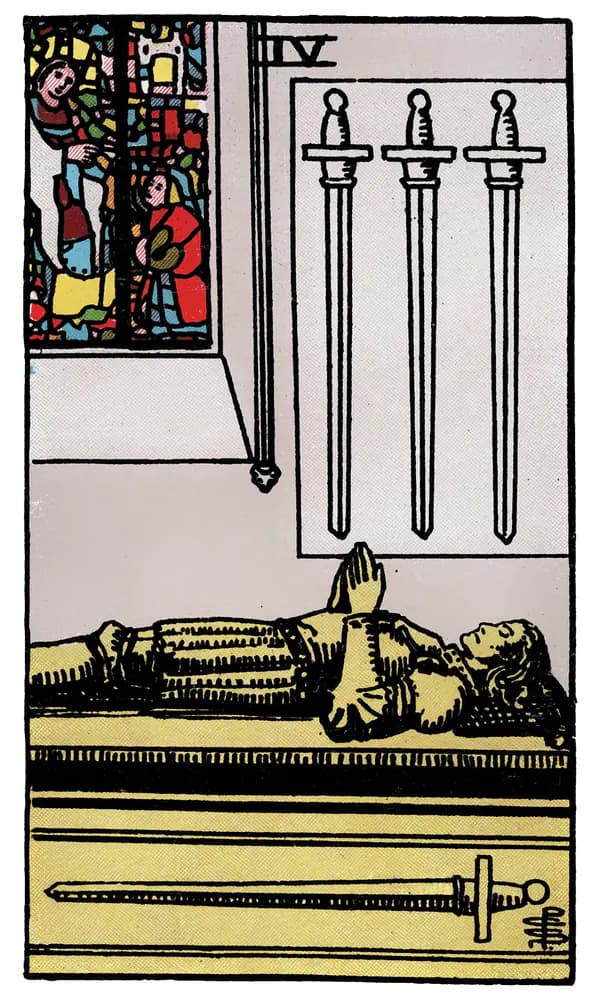
- A knight laid out on a tomb, three swords on the wall and one still beneath him. Rest taken deliberately, not the end of the fight.
- rest · retreat · deliberate stillness
- Reversed
- Rest refused, or overrun. Getting up far too early, or a stillness that has stopped restoring anything at all.
- restlessness · refusing recovery · burnout
The picture
The effigy of a knight lies on a stone tomb chest, in armour, hands together, face up. The figure is drawn entirely in flat gold, with no colour in it at all.
Three swords hang point-down on the wall above him, inside a plain frame.
A fourth is carved along the side of the tomb, beneath him. It is part of the monument.
At the upper left, a stained-glass window shows a small figure in red kneeling before a standing one. It is the only colour in the room.
Upright
Rest taken deliberately, and not the end of anything.
Three swords have been put away on the wall — dismounted, stowed, out of reach. That is the card: a stop that somebody arranged, in a suit that otherwise cannot stop thinking. Convalescence, retreat, the deliberate pause before the thinking becomes any good again.
The prayer posture belongs to the effigy tradition and it is worth reading as one: this is how somebody chooses to be depicted resting, not how they collapsed.
The fourth sword is carved on the tomb
It is often said that he has kept one sword to hand, and the picture does not support it. That fourth blade is engraved into the side panel of the chest. It is masonry.
Which makes the disarmament complete. Three are on the wall and one is decoration, and there is nothing within reach of those folded hands at all.
That is a more demanding card than the half-measure version. The rest here is not a tactical pause with a weapon under the pillow. It is a full stand-down, and the only reason it is survivable is the room: a locked, quiet, stone room with the swords hung up out of the way, which somebody had to build first.
Reversed
Rest refused, or overrun. Getting up too early, generally in order to demonstrate something to somebody who has not asked.
Stillness can also stop restoring anything. The rest continues past the point of recovery, the room becomes comfortable, and what began as convalescence turns into a place that is difficult to leave and increasingly hard to justify staying in.
Commonly mistaken for
Death. The stone effigy invites it and the card does not mean it. This is the most reliably misread image in the suit, and the misreading matters, because the advice that follows from it is the opposite of the advice the card is giving.
A second reading takes it as enforced inactivity — illness, redundancy, something imposed. He arranged this. The whole card turns on the pause having been chosen.
In a reading
In an advice position it says stop, and it is one of very few cards in the deck that means that literally rather than as a figure of speech. In an outcome position, a period of quiet rather than a resolution.
With the Nine the pair sets rest against sleeplessness, and the two cards share a bedroom. With the Hanged Man, two pauses with something going on inside them.