Judgement
Major Arcana · fire
- Upright
- Figures standing up out of their coffins with their arms already open. A summons that wants an answer about who one has been.
- reckoning · awakening · call to answer
- Reversed
- The call heard and declined. Self-judgment mistaken for reckoning, or an old identity kept because the new one asks too much.
- refusing the call · self-condemnation · stuck identity
The picture
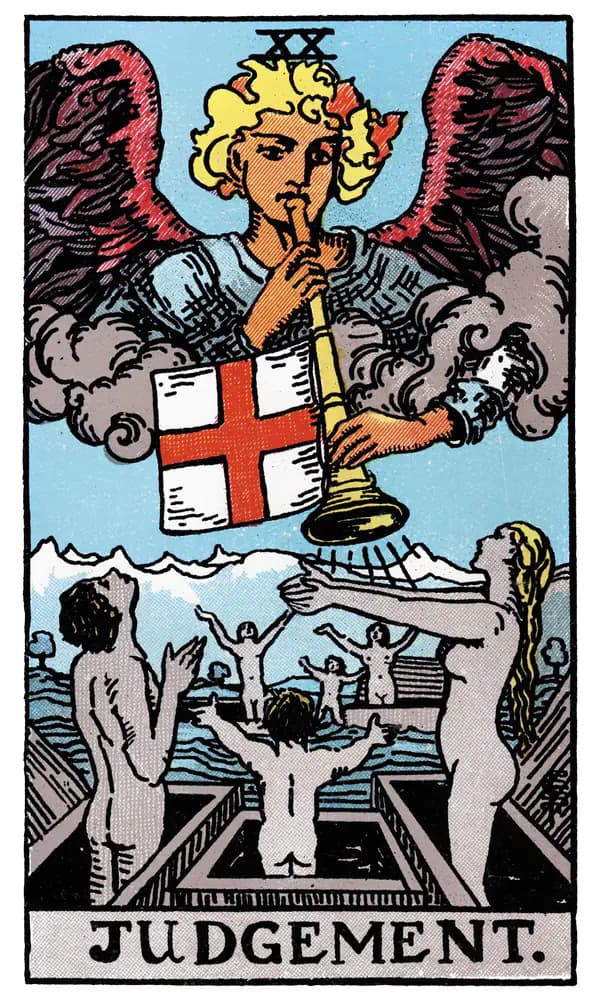
An angel leans out of a bank of cloud and sounds a golden trumpet. A white banner with a red cross hangs from the horn. Below, grey coffins float on a grey sea with their lids off, and snow-capped mountains close the horizon.
Three figures stand in the nearest coffin: a man on the left, a woman on the right, and a child between them. All three have their backs to us and their faces to the angel. The adults have their arms raised; the child's are spread wide, in the same posture as the child on the Sun.
Further back, more coffins, and more people already standing up in them.
Upright
A summons that wants an answer about who somebody has been.
Judgement is a reckoning card, and the plate takes considerable care to make the reckoning welcome. Nobody is being dragged out. The figures are standing under their own power, arms open, faces up — whatever the horn is calling for, they appear to have been waiting for it.
What the card names is the moment a long accumulation has to become a decision. Something assessed, a stretch of life looked at whole, a call that will be either answered or declined. Neither of those is a neutral act, and the card is drawn at the point before either has happened.
They are already standing
Nobody in this picture is being judged by anybody.
The angel blows a horn. That is the entire divine contribution — no scales, no book, no sentence handed down, no list read out. Everything else in the card is being done by the people in the coffins, and they are doing it upward and of their own accord.
The family in the foreground makes the point sharper. Man, woman and child, backs turned, faces up, standing in the same box. And behind them, other coffins, other people, already up. Whatever this is, it is happening to a great many people at once and nobody is waiting their turn to be assessed.
Which relocates the whole card. The reckoning is not a verdict arriving from outside. It is the moment somebody stands up, and the only question the picture poses is whether they will.
Reversed
The call heard and declined. Sometimes for perfectly good reasons — the timing is wrong, the cost is real — and sometimes out of the ordinary fear of what answering it would commit a person to.
Self-judgement also lives here, mistaken for reckoning. The endless private audit that produces no verdict and permits no closure, running for years, feeling like rigour and functioning as avoidance. A reckoning ends. That is most of what distinguishes it.
In a reading
In an outcome position this is a decision that changes the frame and not the details, and the details will look different afterwards without having moved. As advice it says the question has stopped being whether and become whether you will say so out loud.
Beside Death it becomes an ending consciously chosen instead of one that arrives. Beside the Hermit the reckoning is private, and probably overdue.