The Devil
Major Arcana · earth
- Upright
- The chains around their necks are loose enough to lift off. Appetite, attachment, and the part of the bondage that is being chosen.
- attachment · appetite · chosen bondage
- Reversed
- The chain noticed, or drawn tighter. Either the start of getting free, or a dependence that has learned to explain itself very well.
- breaking free · denial · deeper entanglement
The picture
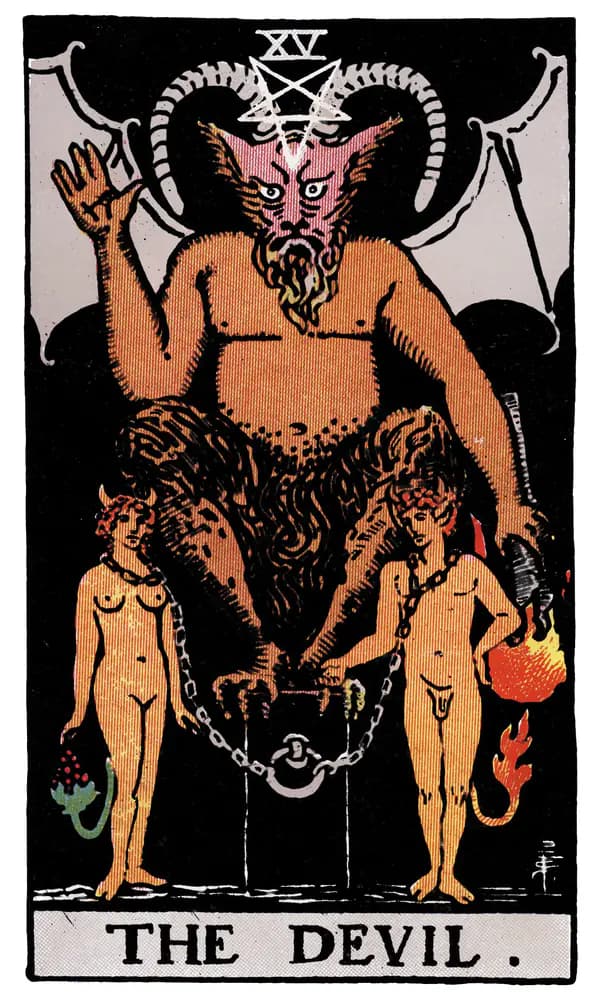
A horned figure with a man's torso, bat wings and bird's feet squats on a black half-cube. An inverted pentagram sits on his forehead. His right hand is raised palm-out in something shaped like a blessing; his left holds a torch pointed downward.
Two naked humans stand chained to the ring at the front of the cube, a man and a woman. Both have grown small horns. Both have tails: hers ends in a cluster of grapes, his in a flame, and the downturned torch is lighting it.
The chains around their necks are loops. They are wide enough to lift off over their heads. Neither of them is doing that. There is no landscape anywhere in this card — the background is flat black, and the arrangement is the only thing in the world.
The chains are loose
Everything the card means is in that one drawn detail, and it is the detail most readings walk straight past.
This is not a picture of imprisonment. It is a picture of an arrangement that could be left and is not being left, which is a different and far more uncomfortable subject. Captivity invites sympathy. What the Devil describes invites something harder, because the exit is drawn into the image at the same size as the chain.
Upright
Appetite, attachment, and the part of the bondage that is being chosen.
The Devil is the card of the thing that is genuinely enjoyable and genuinely costly at the same time. The habit that works. The relationship that is bad for both people and is also the only place either of them is known. The job that pays for a life nobody has time to live. Read as simple vice, the card loses precisely what makes it accurate, which is that something real is being got out of the arrangement.
The tails are the sharpest thing in the plate. Grapes on one, fire on the other: sweetness and heat, two appetites, neither of them evil and both of them literally growing out of the people who have them. The horns matter for the same reason. These two did not arrive horned. The longer a person stands in an arrangement, the more they come to look like it, and the plate gives the process without the verdict.
Reversed
The chain noticed. Sometimes that is where getting free begins — the loop seen for what it is, the pattern named, the thing finally described out loud to somebody.
The reverse motion is also common and looks almost identical from outside: a dependence that has learned to argue. Where it used to have only appetite it now has reasons, and the reasons are good ones, and it will produce them on request. When this card turns up reversed, the useful question is whether the explanation arrived before or after the behaviour.
Commonly mistaken for
Evil, and the reading does real damage. The Devil is not a moral verdict on anybody; it is a description of an arrangement, and treating it as condemnation produces shame. Shame is among the most reliable things for keeping a chain on, because a person who feels disgraced will not look at the thing closely enough to find the loop.
It is read as addiction, too, and sometimes that is right. Just as frequently the arrangement is a job, a story someone tells about themselves, a family role, or a belief that is doing work for them. The black background is the giveaway. What the card describes is total in the sense of leaving no visible outside, not in the sense of being chemical.
In a reading
In a position about obstacles, this card names something the reader has already privately identified and would rather not have confirmed. Where a spread asks what to do, the honest first move is not renunciation but accounting: what is actually being obtained here, on the assumption that something is, because nobody stays for nothing.
Set beside the Lovers, the two make a single question about what a bond is for. Set beside Temperance, the route out is proportion instead of abstinence, which is the version that survives contact with a real life.
Sitting with it
The card is unusually specific about where its difficulty sits. Not in the strength of the chain — the chain is slack — but in the fact that lifting it off means giving up something that is actually wanted.
That is worth being honest about before making any promises. The reason people stay in arrangements like this is not weakness or blindness. It is that the arrangement works, partly, and the part that works is real. Any plan that begins by pretending otherwise tends to last about a fortnight.