Death
Major Arcana · water
- Upright
- The rider comes at the same pace for the bishop and for the child. An ending that is not negotiable, and the sun rising behind it regardless.
- ending · transformation · release
- Reversed
- The ending drawn out. Holding the shape of something long after it has stopped, and calling the exhaustion loyalty.
- clinging · prolonged ending · fear of change
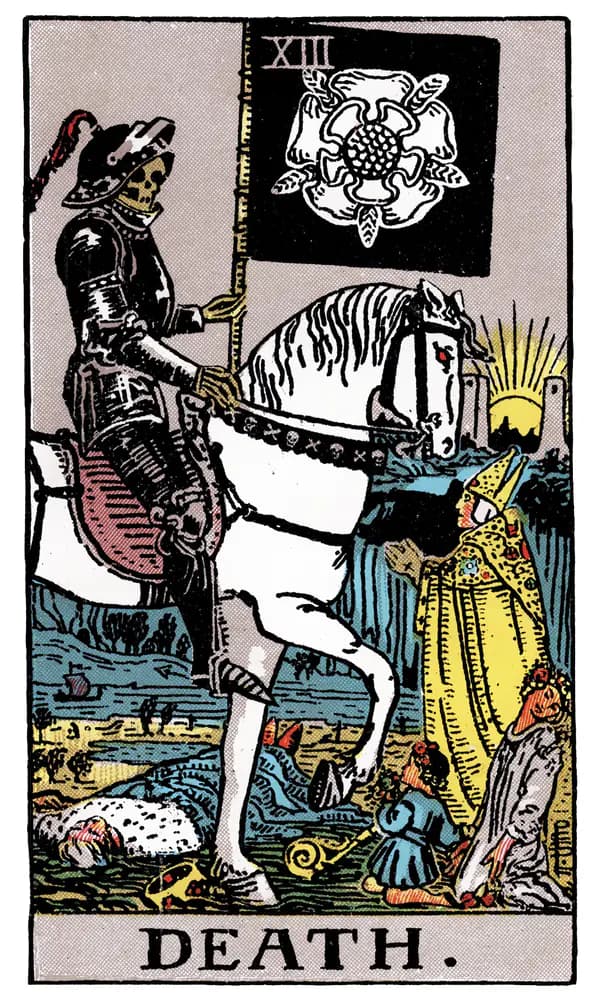
The picture
A skeleton in black armour rides a white horse at a walking pace. The visor is up. From a staff in its left hand hangs a black banner carrying a single white rose of five petals, drawn with the care usually reserved for a coat of arms.
Four people are arranged along the horse's path. A bishop in a yellow mitre stands and faces the rider directly, hands raised. A young woman kneels with her head turned away. A child kneels too, holding flowers, looking straight up at the skull. And in the foreground, already down, is a king: crown fallen off into the grass, body across the rider's line of travel. He does not appear in most descriptions of this card, and he is the most important figure in it.
Behind them a river runs to a distant shore, with a small ship on it under sail. On the right horizon, between two towers, the sun sits on the line. Nothing in the drawing settles which way it is going.
Upright
An ending that is not negotiable.
Death is rarely literal and it is not gentle. What the card names is the point at which something is over irrespective of anyone's readiness, and the horse's pace carries the whole argument. It is a walk. There is no charge, no scythe raised, no violence anywhere in the picture. The rider is simply going to arrive.
Most of what the card asks of a reader is contained in the gap between the bishop's posture and the king's. One is still upright, still performing his office, still addressing the rider in the language he has. The other has already been passed. Whatever the bishop is saying, it is being said after the fact.
The king is already down
This is the detail worth sitting with, because it changes what kind of card this is. If Death were a warning, the king would be the one being addressed. He is not. He is finished before the frame opens, and the picture spends its attention on the three who are still standing and still deciding how to meet it.
That makes this a card about the living. The ending is fixed. What is open is the posture: face it like the bishop, look away like the woman, or look up at it like the child, who is the only one in the picture not visibly afraid.
Reversed
The ending drawn out. Holding the shape of something long after it has stopped working, and calling the exhaustion loyalty.
This is frequently harder to live through than the upright card. Upright, at least the thing finishes. Reversed it does not, and the not-finishing takes up all the available energy — the relationship maintained past its content, the role performed for an audience that left, the project neither continued nor stopped.
There is a second reading, less common and worth checking for: an ending that has already happened and gone unregistered. The situation completed some time ago and nobody said so, and everyone is still turning up.
Commonly mistaken for
Almost every reading of this card begins by saying it does not mean somebody dies, which is true, and which has become such a reflex that the more useful correction rarely gets made.
That correction is about the word transformation. Death is routinely softened into a caterpillar-and-butterfly card, change as a natural and rather lovely process. Nothing in the plate supports it. There is a corpse in the foreground with his crown in the grass. Something is genuinely lost, and the loss is not compensated by whatever follows. The card's comfort, such as it is, comes from the ship and the sun in place of from any promise that the ending was for the best.
In a reading
In an outcome position this is a clean break, and it will cost what it costs. Where a spread asks what to do, the card is unusually blunt: the thing being preserved is already over, and the preserving is the expensive part.
The pairing with the Tower is the one worth knowing. Both are endings; the Tower is an event and Death is a process, and the difference tells a reader whether to brace or to let go. Where cups sit alongside it, the ending has a person in it.
Sitting with it
The question this card tends to raise is how long have I known. Usually longer than is comfortable to admit. The rider moves at a walking pace and is visible from a long way off, and most of the difficulty people bring to this card is not the ending itself but the interval they spent watching it approach and calling it something else.
The sun between the towers is the one mercy in the picture, and it is a small one. The card does not say it is rising. It says only that the light is there, and on the far side of the ending, and that the ship is still sailing.