Wheel of Fortune
Major Arcana · fire
- Upright
- A wheel that turns whether or not anyone is ready. Circumstance moving on its own schedule — the moment is real, and it is not owned.
- turning point · chance · cycles
- Reversed
- The same turn resisted, or arriving badly timed. A pattern coming round again because nothing was altered between passes.
- resisted change · bad timing · repeating pattern
The picture
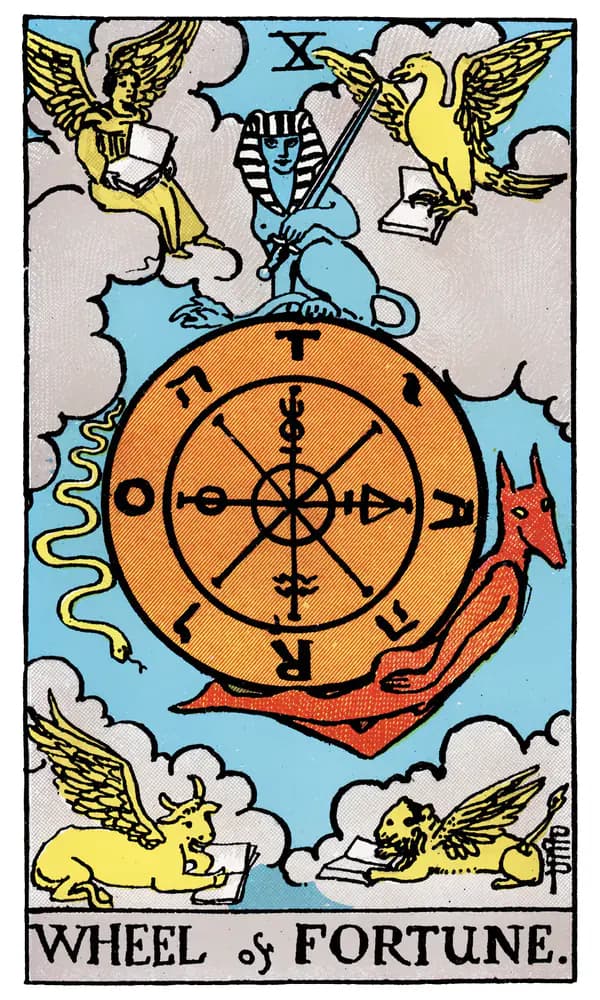
A large orange wheel hangs in a blue sky. Around its rim are the letters T, A, R, O, spaced out with Hebrew characters between them; inside, a second ring of alchemical signs, and eight spokes.
A blue sphinx sits on top of the wheel holding a sword across its shoulder. A yellow serpent slides down the left side. A red jackal-headed figure rises up the right. At the four corners of the card, on their own clouds, sit a winged angel, an eagle, a bull and a lion — and every one of the four has an open book and is reading it.
There is no ground in this card. There is also nothing holding the wheel up, and nobody turning it.
Upright
Circumstance moving on its own schedule.
The Wheel is the deck's card about the part nobody controls. Something turns — an opportunity, a reversal, a piece of timing that had nothing to do with anyone's merit — and it turns whether or not the people involved were ready for it.
What keeps this from being simple fatalism is the four corners. The angel, the eagle, the bull and the lion go on reading through the entire revolution. Something in the picture is outside the turning, and the card is careful to draw it four times.
Nobody is turning it
Medieval wheels of fortune have a figure at the side working a crank. Fortuna, usually, blindfolded, cheerfully ruining people. This card does not have one.
The wheel hangs unsupported in open sky, no axle, no frame, no hand on it. That absence changes the card's whole temperature. There is no one to appeal to, no one being unfair, and no one who could be persuaded to stop. What is happening is not being done by anybody.
Which is either the bleakest thing in the deck or the most consoling, depending on where the reader currently is. Nothing about the turn was personal. It was not deserved and it was not aimed, and a great deal of the suffering people bring to this card comes from having assumed otherwise in one direction or the other.
The serpent goes down the left, the jackal comes up the right, and the sphinx sits on top with a sword and does not descend at all. Three positions on one object. None of them is a reward.
Reversed
The same turn braced against. An obvious change resisted instead of used, energy spent on holding a position that the wheel has already left.
There is also a version where the wheel comes round to the same place. A pattern arriving again because nothing was altered between passes — the second job that resembles the first, the third relationship with the same argument in it. The turning is real; only the destination repeats.
What it is not
Good luck. The Wheel turns, and turning has no direction attached to it. Roughly half the time this card names the moment a run of ease quietly ends, and reading it as a promise sets people up badly.
It is also read as fate in the sense of nothing being possible. Look again at the four corners, still reading, through the whole revolution. The card puts an enormous amount of drawing effort into establishing that something continues regardless, which is a strange thing to do if the message were simply that nothing can be done.
In a reading
In an outcome position the card says the situation changes, and declines to say into what — which is unhelpful and is also, occasionally, the honest answer. In an obstacle position it names an attempt to control something that was never anyone's to control, and the relief on offer is the relief of stopping.
Justice makes the sharpest pairing available. One card is consequence and the other is chance, and almost every real situation is some proportion of both. Most of the argument in a reading is about the proportion.