The Magician
Major Arcana · air
- Upright
- Every tool already laid out on the table, and one hand raised to draw the power down. Capability meeting the will to use it.
- will · resourcefulness · focused action
- Reversed
- The gesture without the work behind it. Talent scattered, or turned to persuasion — the trick performed instead of the thing made.
- manipulation · scattered effort · all talk
The picture
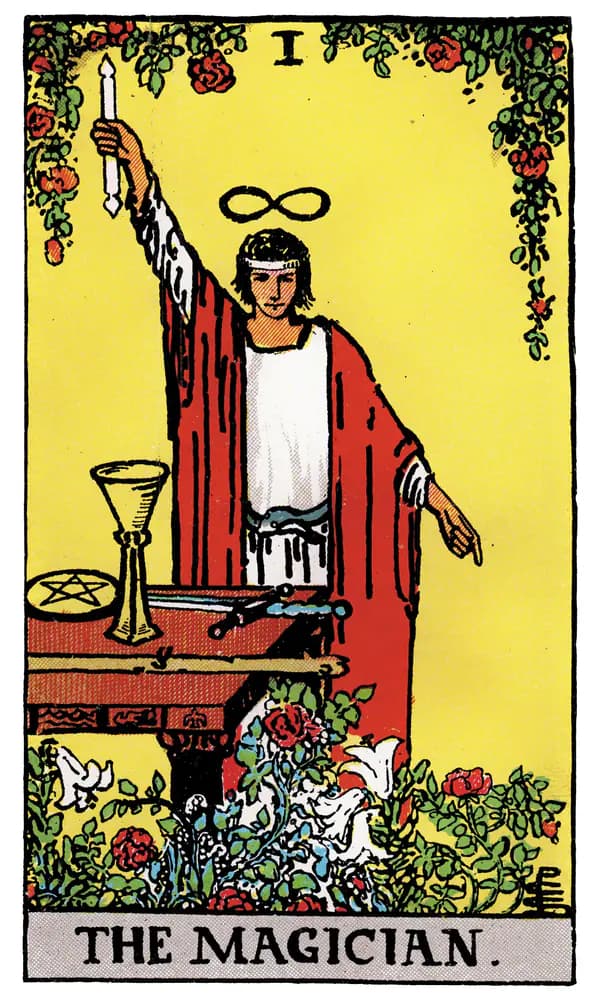
A figure in a red robe over a white tunic stands at a table. His right arm is raised, holding a white wand pointed at the sky; his left hand points at the ground. A lemniscate floats above his head, and the belt at his waist is a snake with its tail in its mouth.
On the table lie four objects: a cup, a coin marked with a pentacle, a sword, and a wand. That is the raw material of the entire deck, laid out and already within reach. Red roses hang from a bower above him and roses and white lilies grow thickly at his feet. Behind all of it, a flat yellow ground with no landscape in it at all.
Upright
Nothing is missing. That is the card's claim and also its difficulty, because it removes the last respectable reason to wait.
The Magician is capability meeting the decision to use it — not talent as a property somebody has, but talent aimed at something. What separates him from the Fool is knowing what he is carrying. What separates him from most of the rest of the deck is having concluded that it is enough.
The gesture matters more than any of the objects. He draws down with one hand and points out with the other, and the whole work is in that transfer: taking something that exists in one form and moving it into a form where it can be used.
The fifth implement
Count what is on the table and then look at his hand.
Cup, coin, sword, wand — four. The wand he is holding up is a fifth object, white and double-ended, and it is not one of them. He did not find it there. He brought it, and it is the only thing in the picture that came from outside the picture.
Whatever that fifth thing is, it is the reason this is a card about a person and not a card about equipment. The four suits are the situation: everybody gets those. The raised wand is what somebody does with them, and it belongs to him in a way the table does not.
The snake belt makes the same point from the other side. An ouroboros is a closed loop, endlessly renewed and going nowhere, and he is wearing it as clothing. The loop is the material. He is not inside it.
Reversed
The gesture with no work behind it.
This comes out in two shapes and both feel identical from within. Talent scattered — everything on the table, nothing picked up, capability spread so thin that it never touches down anywhere. And capability turned toward persuasion, where the trick gets performed instead of the thing being made, and the performance improves steadily while the making does not.
Reversed, the tell is the audience. The upright card has nobody in it.
Commonly mistaken for
Charisma, which is almost the opposite of what the plate shows. There is not another person anywhere in this card. He is not convincing anybody of anything; what he is doing is technical, and reading it as charm loses the table, which is the part that makes the card useful.
The second misreading is more expensive: taking it as a guarantee. The Magician says the means are to hand. That is a real claim and a much smaller one than saying the thing will work.
In a reading
In a position about beginnings this is the most direct card in the deck, and the instruction is simply to start. In an obstacle position it tends to mean the resources are already present and the reader is proceeding as though they were not — waiting for a permission, a qualification, or a piece of equipment that is lying on the table.
The suits around it change what is being made. Among cups the work is emotional; among swords it sharpens toward argument, and can slide into the reversed reading without ever turning over.