Six of Cups
cups · minor arcana · water
- Upright
- Children in an old garden, one handing the other a cup filled with flowers. Sweetness that belongs to the past, and is real for that reason.
- memory · tenderness · innocence
- Reversed
- The past preferred. Memory kept polished while the present goes untended, or a tenderness never allowed to grow up.
- living backwards · nostalgia as refuge · immaturity
The picture
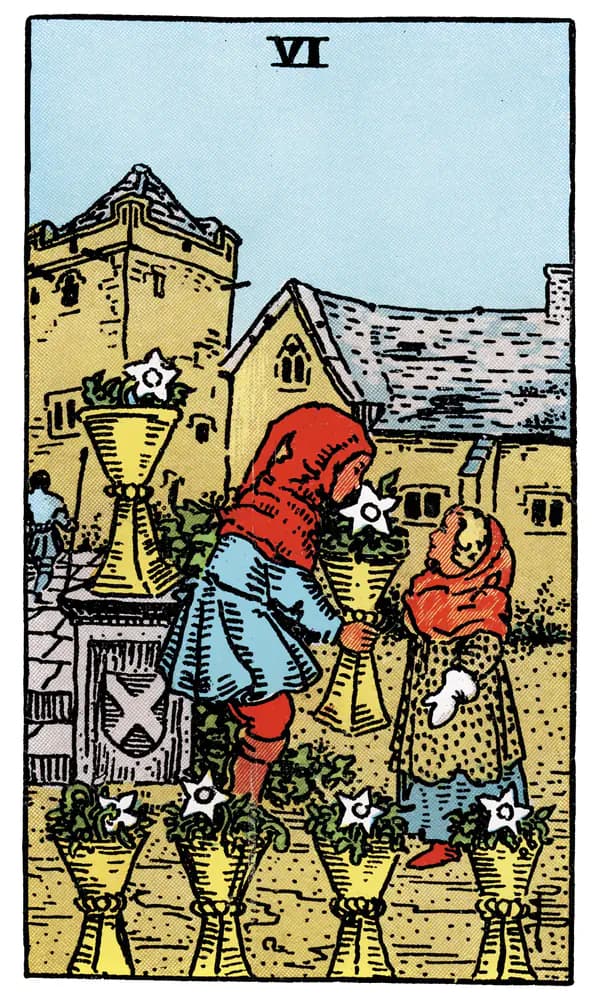
Two children in a courtyard of yellow stone. The taller, in a red hood and a blue tunic, bends forward to hand a cup to a smaller child in a red hood and a spotted dress. Inside the cup, a white flower with five petals.
Six cups in all, every one of them flowering. One stands on a stone plinth carrying a shield with a saltire on it; four more stand along the bottom of the card.
In the background, on a path between the buildings, a guard with a halberd is walking away.
Upright
Sweetness that belongs to the past, and is real for belonging there.
The Six of Cups is memory, and specifically the uncomplicated kind: childhood, an old friendship, a place that was simple, something familiar coming back round. The white five-petalled flower in the cup is the same bloom that hangs on the black banner in Death, which is a strange and quite deliberate echo — the flower turns up where something has ended.
The card gets read as naive and is not. It knows the courtyard is walled. What it maintains is that the sweetness was genuine, which nostalgia usually is at its source, whatever it becomes later.
The guard is leaving his post
There is an adult in this picture and he is walking out of it.
He carries a halberd, so the courtyard was being watched, and he is heading away up the path with his back turned. The two children are handing flowers to each other inside a place that has just stopped being guarded.
That figure is why this card is not simply warm. Safety of this kind is conditional, somebody was maintaining it, and the picture is drawn at the moment that person leaves. Whatever is being remembered here was held in place by arrangements the children were not aware of and could not have kept up.
Reversed
The past preferred to the present. Memory kept polished and well lit while the things currently happening go untended, and the polishing taking up real hours.
There is also a tenderness never permitted to grow up. Innocence maintained rather than kept — a different and more effortful thing, costing a little more each year it goes on, and generally defended with great charm.
What it is not
A literal reunion, though it can be. It is more reliably the past arriving in the present as a feeling and not as a person, and a reading that promises somebody at the door usually disappoints.
It is also written off as regression. Returning to something good is not automatically a retreat, and this card is markedly more generous than its reversal.
In a reading
Something familiar returns, in an outcome position, and it will feel older than it is. Asked what to do: the old way is worth consulting, which is not the same as adopting it.
With the Five the sequence runs grief into memory, one card apart. With the Eight the pair puts a question about whether to stay inside something that was good and may have finished being good some time ago.